May is Bike Month but it is also National Clean Air Month

We are still in May but since it’s Bike Month, we decided to post two blogs to celebrate! This is your dutiful council member blogger, Nora, here to share the wonders of May with you. As a pedestrian advocate, I have learned that transportation touches so much more than just our roads and paths. By creating a more bikeable environment we improve health, provide more affordable means of transportation, improve the health of the environment, and so much more. Transportation, especially biking, has a positive impact on so many sectors of our lives. Today, I am going to talk about one of those sectors– decreased emissions, and we know we aren’t the only youth group to believe this.

May is Bike Month but it is also National Clean Air Month. Clean Air Month was started by the American Lung Association in 1972 as a week-long event and later initiated the enactment of The Clean Air Act, one of the first pieces of environmental protection legislation. This month allows for reflection on how we can improve air quality both indoors and outdoors. Now in DC as in other places another contributor to air quality is pollen especially during cherry blossom season. As someone who is from Georgia, pollen usually doesn’t phase me but the pollen in DC is on a whole different level. Although the flowers are very nice to look at. However, pollen is not a malicious emission but carbon is. Part of the focus of Clean Air Month is to reduce our carbon footprints and one of the ways you can celebrate both Clean Air Month and Bike Month is to bike to work because vehicles are the biggest air polluters.

Clean air is not just good for the environment, it’s good for all of our health, as poor air quality can contribute to cancer, bronchitis, allergies, and asthma. An easy way to see the effects of poor air quality is by looking at sunsets, heavy orange and red sunsets show that there are a lot of particles in the air either from fires, volcanoes, or pollution. These particles trap the light allowing for the longer wavelengths such as red and orange to show in the dusk sky. But every individual can do something about it! How are you participating in Clean Air Month, Brian? How do your sunsets on the West Coast look?

To see the air quality of where you live click here.

Expand Your Mind With Bikeshare

Aloha May! It’s your favorite council member blogger, Nora, and it is finally getting consistently warm and sunny here in Washington D.C. This makes May one of my favorite months because it’s perfect weather for National Bike Month. There is nothing better than a sunny day with a bike-fueled breeze to cool you off. National Bike Month was started in 1956 by the League of American Bicyclists to promote bicycling around the nation, with a Bike to Work/School Week (May 15-21) and Bike to Work/School Day on May 19th.

Even if you don’t own a bike, there are still many ways to participate, such as through bike share programs. Bike share is a system that allows people to access bikes in stations across the city through either single-time payment or with memberships – you can get to a local bike share station by train!

Washington D.C. became the first place in the US to implement a bike share known as SmartDC in 2008, which is now known as Capital Bikeshare. Now, all 50 states have followed suit. Capital Bikeshare is a station-based system where you can pick up and lock up your bike after your trip. However, there are bike share programs that don’t have these docking stations that you may have seen, including JUMP and Lime e-bikes. There are also hybrid systems that allow users to pick up at a station and lock bikes somewhere else combining both reliability and flexibility, such as Divvy Bikes, Blue Bikes in New Orleans, and BIKETOWN in Portland.

Bike share programs aren’t just good to get you where you need to go in a cheaper, sustainable, and time-saving manner, but they also help reduce air pollution making your community healthier. So definitely check out a bike share program if you come across one this month or whenever because biking can be and should be enjoyed all the time! Brian, do you know of any bike share programs? How are you celebrating National Bike Month?

If you want to learn more about your state’s bike share programs, click here.

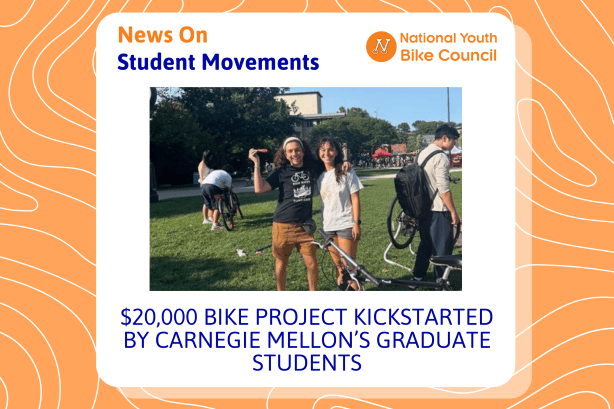
$20,000 Bike Project Kickstarted by Carnegie Mellon’s Graduate Students

t’s called the Tartan Bike Project.

What’s top of mind for college students these days? Freedom to move, affordable transportation, and finding real, meaningful friendships. That’s the spirit behind the Tartan Bike Project, launched by two graduate students, Kenedy and Hosea, who together raised $20,000 toward an on campus ‘Bicycle Project’.

Naturally, we were curious—how did they pull that off? In short, it took a lot of planning.

Since last year, the pair have been moving on launching a bicycle repair & rental space on campus in their free time. Its goal? To create a welcoming space where Carnegie students can gather around bikes, get repairs, borrow a ride, and keep campus life active and mobile—especially in the warmer months.

We Interviewed Kenedy

Moving to a new city was difficult,” Kenedy shared. “OBP was a big part of my community, so I wanted something similar in Pittsburgh.

She’s talking about the Orange Bike Project at the University of Texas (UT) in Austin, where she did her undergrad. It was a student-run campus bike program that offered not just tools and repairs—but community. That experience sparked the inspiration behind the Tartan Bike Project.

When Kenedy started college at UT, she got a bike. Then she saw a call for volunteer mechanics at the Orange Bike Project. That was her entry point—not just into fixing bikes, but into a unique kind of student environment with a shared vibe and purpose. The bike shop became her second home.

After moving to Pittsburgh and meeting Hosea, Kenedy found herself in familiar territory—needing to fix her bike. On top of the need to fix it, she was getting ready to invest in a better and higher-end bicycle. The gap of there being no on-campus bicycle spaces got the pair thinking, maybe they were not the only ones with this issue.

After about a semester of listening and getting used to Pittsburgh, they figured out they were right. They were not alone in their needs. The hesitation amongst their peers to invest money or time to learn about bicycles mostly stemmed from a lack of repair support on campus. That growing need, mixed with their own desire for a shared student space, gave a new meaning to something bigger: the Tartan Bike Project.

Getting $20,000

The first part of the journey to starting a Bike Project was not straightforward but they had an idea: a pop-up bicycle stand. Hosea and Kenedy printed a ton of posters and hung them up around the bicycle racks on campus, drawing in over 80 students to their one-day pop up bicycle stand. To make sure it was not a fleeting idea, the two prepared a survey which about 40-50 students filled out, where they asked for volunteers, opinions and needs.

This initiative was so successful that the pair were invited to table at Bike Week which came up a few months after the pop up table. This initiative was run by Transportation Services at Carnegie, led by Michele Porter, the department’s Director. This event offered bicycles that were left around campus to passing students alongside a lot of other amenities from off-campus bicycle providers. The main issue the two noticed was that the bicycles that were given away would end up abandoned again because students had no clue on how to fix up the bicycles. With the help of Kraynick’s Bike Shop, who provided them the tools, the opportunity turned into another promising success, where they fixed as many bicycles as they could that day, building their case for why an on-campus bicycle project was needed.

They worked closely with the school and some friends from Pitt Bike Cave to curate a proposal that went through the Graduate Student Assembly. Simultaneously, they made sure to make friends along the way with Michelle Porter.

Reflecting back, Kenedy mentioned that her role models for starting the Bike Project were more
than just the Orange Bike Project students, but Yellow Bike (also located in Austin), Pitt Bike Cave (located in Pittsburgh), and FreeRide. Each organization’s presence in her communities helped make an impact on Kenedy’s decision that an on campus Bike Project would be worth it.

The proposal was approved by the Graduate Student Assembly which got them a multi-year commitment to support the Tartan Bike Project with $20,000. (Later, the Graduate Student Assembly would approve another 3K of additional funding to support other more immediate project needs.)

What’s Next?

Connect with people around you.” That was one piece of advice Kenedy mentioned for students who are considering starting a bicycle project at their university. Their current challenges are now putting into action all the needs they mentioned in the budget.

Hosea and Kenedy know their project is long lasting as support in their work from Carnegie demonstrates the university’s multi-year financial commitment to student transportation needs and fostering on-campus student relationships. The two have big plans and wishes, all the way from offering credited classes with the Tartan Bike Project to being a part of the school’s Transportation Service department.

Tartan Bike Project will be open Fall 2025, starting with a few regular hours, and some social aspects.

Do It Yourself

Hosea and Kenedy are not the only ones with on-campus bicycle projects. There are other long-standing bicycle projects that have figured out what makes a university bicycle project work.

Tatiana from Georgia Tech, is the former president of Starter Bikes, a bicycle project very similar to Tartan Bike Project, at a Bicycle Friendly University has agreed to give us the ‘Essentials to start a College Bicycle Program’ on July 14th at 11:30 AM ET. During the webinar, Tatiana, will break down the essential resources you need to start or sustain a bike program on your campus. From sourcing tools and parts to securing space and allies, she’ll share practical tips and lessons learned from running a thriving student-led bike shop at Georgia Tech.

What It Feels Like To Be New To The Bicycle Space

e usually try to spotlight youth ages 24 or younger, but Raven, who is currently employed with the League of American Bicyclists, is a recent 25-year-old and the youngest staff member on the daily team. In addition, Raven is also fairly new to the bicycle advocacy space and, believe it or not, she got a chance to participate in her first lobbying session through the National Bike Summit!

Since this was Raven’s first time attending the National Bike Summit (Bike Summit 22) as a staff member, her experience was divided between attending sessions and facilitating others. On top of that, Bike Summit 22 had multiple ways to attend: “It was a love-hate relationship with being able to meet advocates and attend sessions in-person but also balancing attending virtually while taking on the responsibilities of being an admin for the event,” Raven expressed. “I left this year’s Summit knowing that there were still many conversations for me to listen in on and so many more advocates to meet next year.”

Raven was the facilitator for our presentation, where we spoke about how stigma, law enforcement, and infrastructure played into preventing the expansion of urban cycling. She kicked us off and had some great feedback at the end of the presentation: “The topic was really relevant and relatable.”

Other presentations that sparked her interest as a first-time attendee and admin were a presentation on how to encourage local businesses to apply to the Bicycle Friendly Business program and conversations around finding new community spaces to encourage people to ride bikes. Right on point, because she was trying to gain confidence for riding a bicycle to the National Bike Summit in D.C. for the first time. Raven described the journey as a scary, but fulfilling experience, noting that Bicycle Friendly Communities and the topics around expanding infrastructure appealed to her as someone with little to no experience riding in an urban environment.

“The presentation was easy to digest and was broken down very well. Also, no one presented a game at the end of their presentation like what I saw the National Youth Bike Council’s presentation do!” – referring to our version of ‘finding Waldo’. The game was short and sweet and may still be available if you take a look at what participants had to do to win!

Raven mentioned, “I was trying not to lose my ‘host face’ even though I agreed with a lot of what you all were saying.” She goes on to say that statistics aren’t just numbers when it comes to law enforcement. Saying that before she joined the League of American Bicyclists she was not aware of the statistics, but she knew enforcement was an issue from her own personal experience, “it’s good to hear that the stats are not just stats, they are reality.”

“I did not think people could be so angry and resentful towards people on bicycles,” this statement is a common theme among the youth community the Council is boosting and was included by Raven in her feedback to us about the presentation. She also mentioned how she was pretty disconnected from the whole movement in general before joining the League, but not on purpose. Raven was more of a walker and learning about all the notions around bicyclists was an enlightening moment at our presentation and throughout the experience of the National Bike Summit, this makes the reason behind her day-to-day work stronger.

Actually, she did not learn to ride a bicycle until the age of 24, which is a fun fact. She also pointed out that if she had not been embarrassed to tell her friends she did not know how to ride a bike, she would have given the bicycle a chance sooner. She believes that riding bicycles together removes a portion of the fear a younger rider may experience riding alone in the city, “just one other person was enough to get me to ride.”

As said by her team, Raven’s service is a great addition to the team because she has not been exposed to the bicycle space before and brings a fresh and younger perspective. Through facilitated connections and conversations we hope many of the youth in this growing community can get opportunities and be essential to the bicycle space like Raven.

We thank the League for giving us a great experience at the National Bike Summit this year! Happy Bike Month!