Author: Council Member Nora
Hello! This is Nora from the National Youth Bike Council team writing to you from Santiago, Chile! While the US is entering spring here on the other half of the world it’s getting colder and colder as we enter fall which is taking some time for my mind to understand.
I am currently studying abroad and among many things I have learned in my time away from the US is that our relationship with cars and bicycles seems to differ from the rest of the world. According to a report by the New York Times, “In 2020, as car travel plummeted around the world, traffic fatalities broadly fell as well. But in the U.S., the opposite happened. Travel declined, and deaths still went up.”
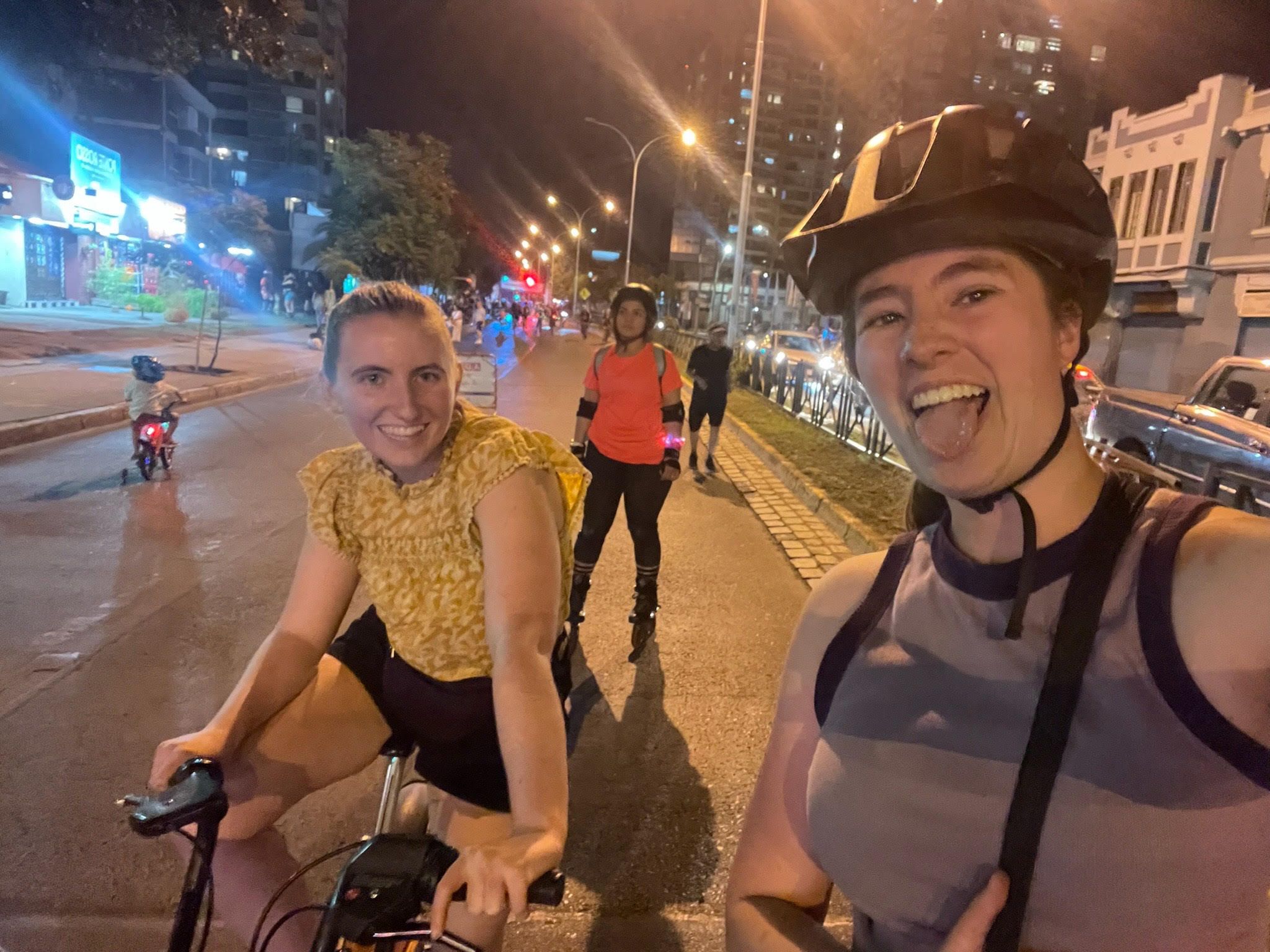
This report surprised me because I don’t believe Chileans are more accustomed or more respectful towards bikers. There are plenty of gaps in Santiago’s biking infrastructure, but one approach I found interesting that Santiago is doing is that every Sunday major streets are closed to cars and bikers, runners, scooters, and anything without an engine take over. It doesn’t happen all day but it is a good chunk of the day and a great way to feel safe and comfortable on the bike while getting to know the city in a different way.
I also got to participate in a night ride, which had the same set up of street closures but everyone was lit up with lights, there were concerts in parks along the route, and families were out together. I felt like I could safely bike around while also getting to know the community.
Now as to why the US is such an outlier in the world we don’t really know but there are a lot of possible reasons. One is that, as Jennifer Homendy, chair of the National Transportation Safety Board said, “Motor vehicles are first, highways are first, and everything else is an afterthought.” I think for bikers this often manifests itself through a feeling like you are not welcomed or you should not be there often because there is no lane for you.
Other theories deal with the kinds of cars Americans drive: often bigger and automatic. Bigger cars mean slower breaking and that pedestrians are hit at a higher point than the legs. Automatic cars means that drivers don’t have to use two hands whereas a stick shift requires a lot more of a driver’s attention, with less attention required in automatic cars drivers are more likely to become distracted by a phone or messing with the radio. Modern cars are also coming with more technology which means more buttons and screens and dials to distract drivers.
“A livable community is one that provides safe and convenient transportation choices to all citizens, whether it’s by walking, bicycling, transit, or driving.” Around the world and unfortunately increasingly in the US communities are not safe for pedestrians, “Each year, unfortunately, pedestrian and bicyclist fatalities comprise about 19 percent of all traffic fatalities with approximately 6,000 pedestrian deaths and 850 bicyclist deaths. Another 76,000 pedestrians and 47,000 bicyclists are injured in roadway crashes annually.”
For me this is a reminder of why we do the work we do at the National Youth Bike Council. Why we need to take perspective from not just the loudest but also the youngest of all pedestrians, because the problem is getting worse. Even a pandemic which significantly decreased the amount of cars on the road did not decrease pedestrian deaths, which means our infrastructure is falling short.
There are many theories why pedestrian deaths are increasing but there are also many ways we can try and change that. From a personal level this can look like reaching out to your local government about places where you see gaps in pedestrian infrastructure. At a community level we can look at Santiago, starting out by handing over streets to pedestrians once a week. At a national level you can join our volunteers or volunteer for organizations like Vision Zero where we either give resources or help organize initiatives that teach a specific set of pedestrians how to avoid common mistakes drivers make. We work to change the fact that the US is an outlier in the world of pedestrian fatalities. So as Bike Month is coming up I hope we can take some time to learn about the problem (or problems)and the solutions. See you next month!
If you want to learn more about how lower income communities are disproportionately affected check out Smart Growth America. Or additional resources.
For more theories including people moving to the Sun Belt check out the Daily Podcast from the New York Times.