Author: Council Member Nora
Happy New Year to all! This is your blogging council member, Nora, here to kick off 2024 with you. For our resolution, we’ve decided to slightly change our approach to these blogs by including, along with what the Council is doing, more in depth investigations into topics that youth in transportation are interested in.
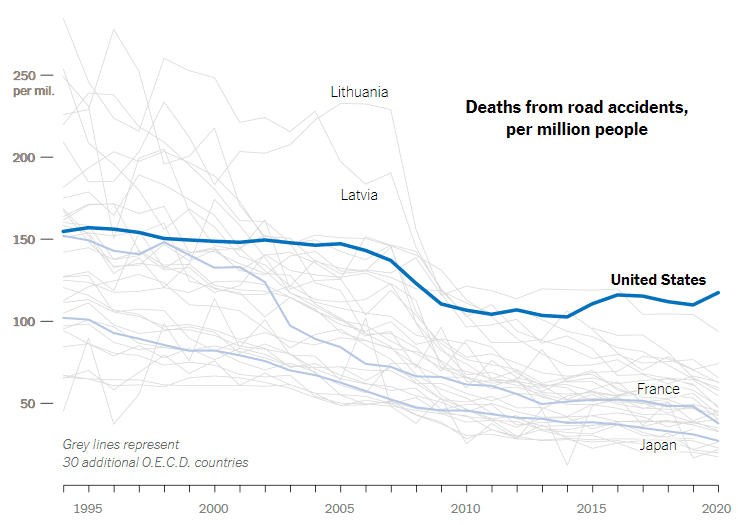
There is a growing recognition that pedestrian deaths are and will continue to rise every year and that the US is outpacing other countries in pedestrian deaths. While these statistics are not good, greater awareness about the problem and showing that other countries are dealing with pedestrian safety in more successful ways means there is even more pressure on US governments on all levels to make an effort to change our car focused mentality.
Hearing about this increased recognition of the US’s pedestrian safety problem gave me a moment of ‘yes! Thank you for seeing what is happening!!’ As I was celebrating this small step towards progress, a friend called to my attention a problem in pedestrian safety I had not been seeing. So in this blog, I want to highlight a growing group of those pedestrian fatalities that are often forgotten – those without permanent residence.
Those who are experiencing homelessness are a vulnerable community to start off in terms of impact. However, they are particularly vulnerable to traffic fatalities as they are more likely to be living next to roads and high traffic areas such as highway interchanges and major road underpasses (2 – Why Are So Many More Pedestrians Dying in the US?). High-speed corridors, even with the danger they present, offer a particular refuge because the land next to highways is public land. Underpasses and bridges offer protection from weather and the relatively remote location as well as the public land aspect means individuals are less likely to be told to leave by police or land owners. This means they are more likely to be near cars at night, which is when most pedestrian deaths are occuring. There are many other factors that make this community more vulnerable to pedestrian fatalities including not being able to use other modes of transportation including cars and buses due to costs (4 – Homeless More Vulnerable To Pedestrian Accidents). These factors depend on the individual and their situation but in general if you are experiencing homelessness you are more likely than a housed person to die as a pedestrian in a traffic related incident.
Los Angeles has found that those experiencing homelessness are 53 times more likely to be killed in traffic violence than the national average. According to the Portland Bureau of Transportation, in 2021 “seventy percent (or 19 out of 27) of pedestrian deaths were houseless community members; and 33 percent (21 out of 63) of all traffic deaths were houseless community members.” (3 – Traffic Crash Report 2021) These statistics are talking about Portland, Oregon in particular but nation-wide there has been an increase in people experiencing homelessness pedestrian deaths. Across the nation those experiencing homelessness make up between 60% (in Colorado Springs) to 15-20% (San Francisco) of traffic deaths (1- Living Without Refuge).
When the problem is laid out in front of you it’s clear why those who are experiencing homelessness are more vulnerable to cars, so why do we often forget to include this community in our talks towards a safer transportation environment? While advocating for young people specifically, we empathize with this group of overlooked pedestrians, because we know what it feels like to be a part of an overlooked group of road users. One of the reasons, I think, is that most cities/counties/states don’t monitor whether someone was experiencing homelessness and so the data is not collected. This makes it hard to understand the size of this national problem.
However, some cities are starting to include this data into their reports. 2021 was Portland’s first year of including homelessness into their pedestrian fatality report. They went from 70% of pedestrian fatalities were people experiencing homelessness in 2021 to 36% in 2022. When we acknowledge the problem, as the US is starting to do with general pedestrian safety, we can make changes to achieve solutions. To do this we can’t forget about communities, in order to achieve Vision Zero (where there are no pedestrian fatalities) we need to see how everyone is impacted.
If you’re interested in learning more, check out the below resources on this topic:
1 – Usa.streetsblog.org Living Without Refuge
2 – Why Are So Many More Pedestrians Dying in the US?
3 – Portland.gov Traffic Crash Report 2021
4 – 13wmaz.com Homeless More Vulnerable To Pedestrian Accidents